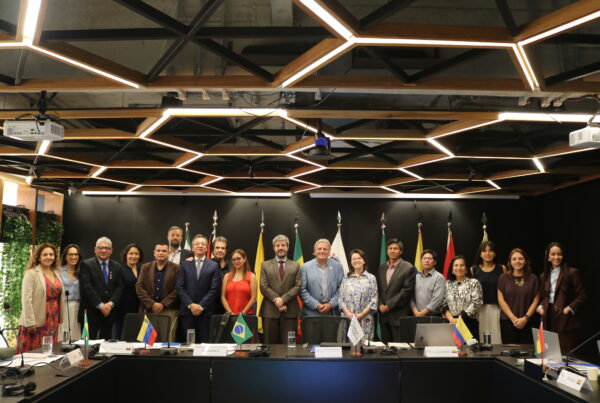
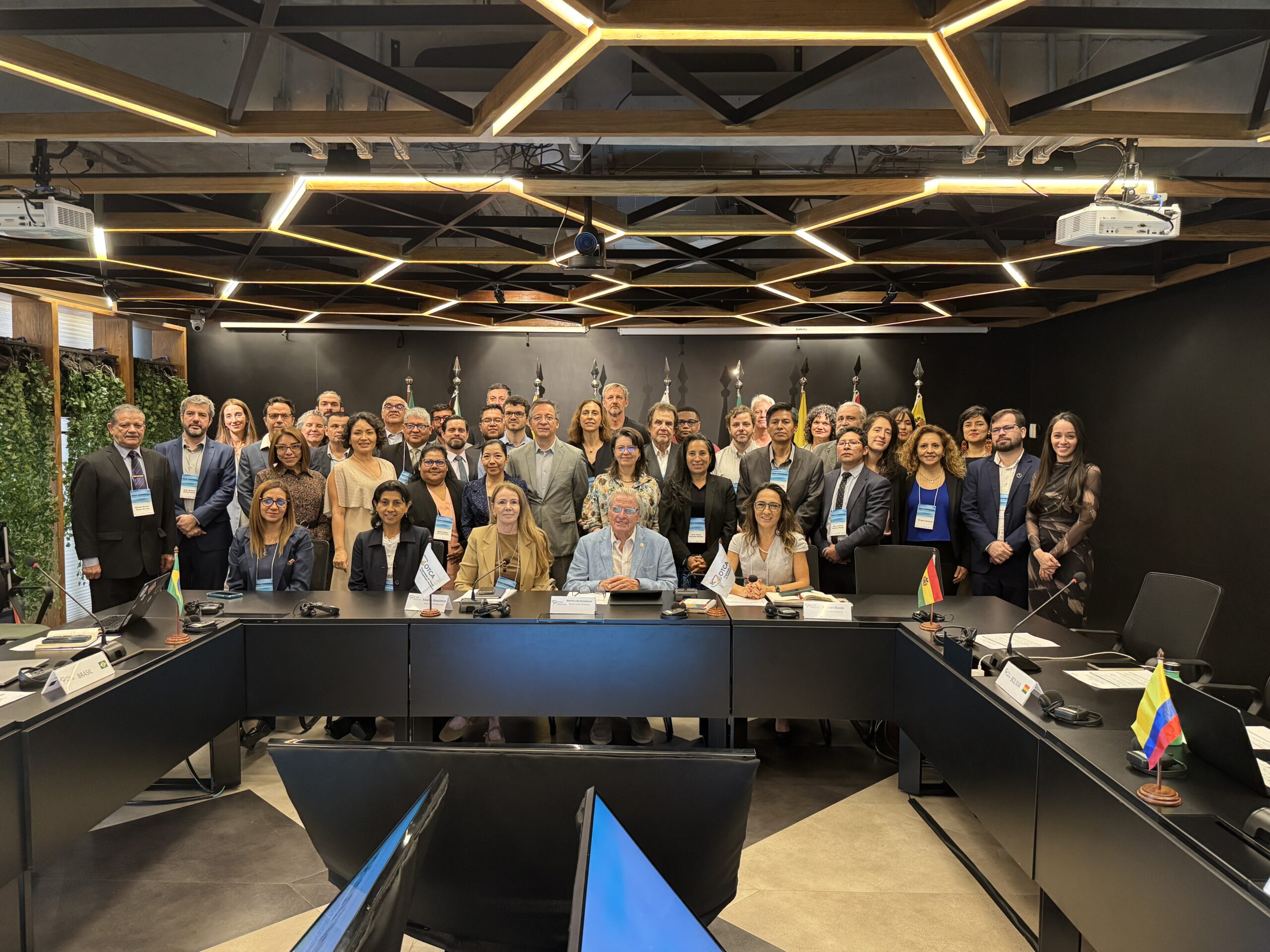
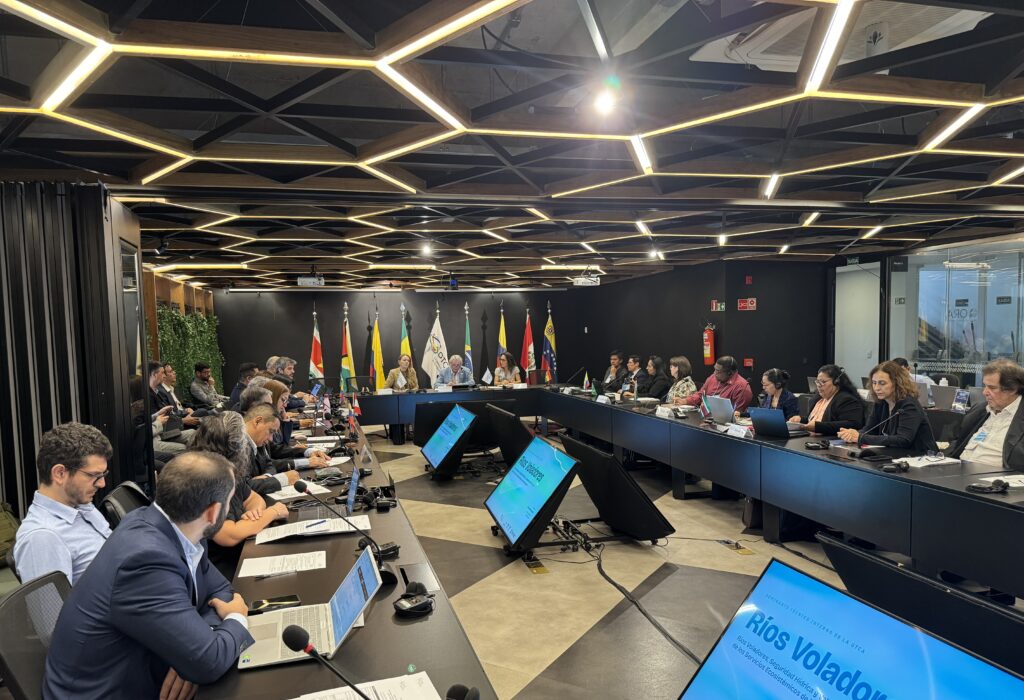
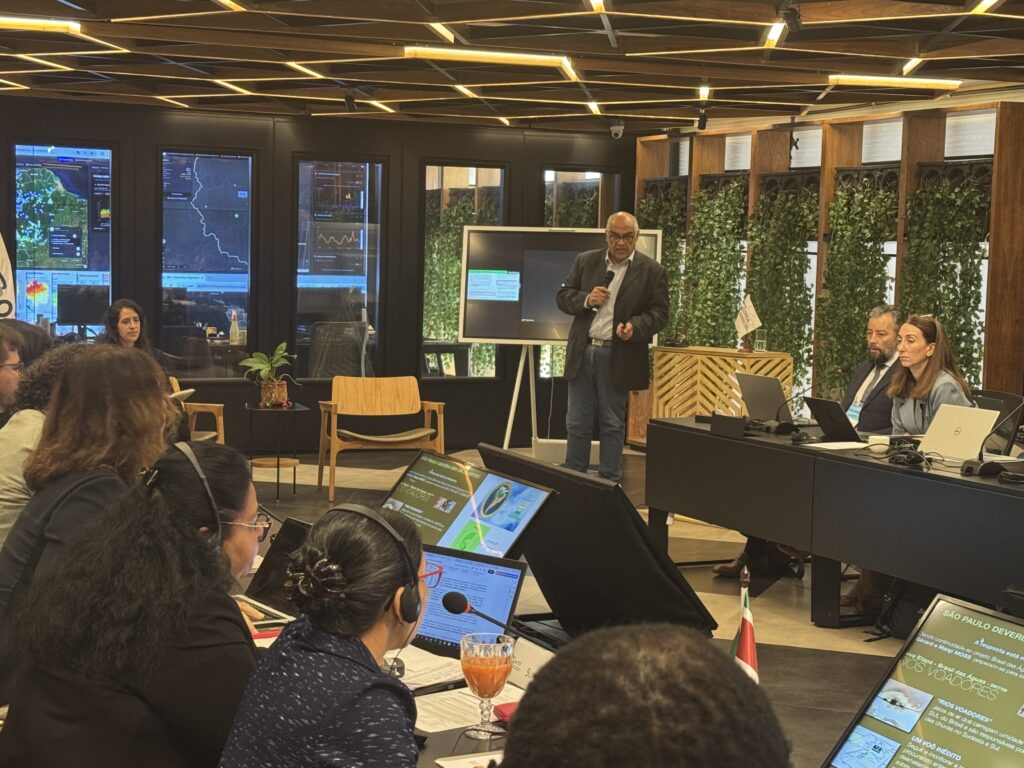
Expanding understanding of flying rivers and discussing how this knowledge can contribute to water security, decision-making and the valuation of Amazon ecosystem services was the focus of the Internal Seminar “Flying Rivers, Water Security and Economic Valuation of Amazon Ecosystem Services,” held on October 7 at the headquarters of the Permanent Secretariat of the Amazon Cooperation Treaty Organization (PS/ACTO) in Brasília.
The event brought together experts in climate, hydrology, ecology and economics, representatives of ACTO Member Countries and partner institutions to discuss the state of knowledge on Amazonian moisture flows, the territories that depend on them and the economic value of the hydroclimatic services provided by the forest. Monitoring, governance, financing and opportunities for regional cooperation were also central to the discussions.
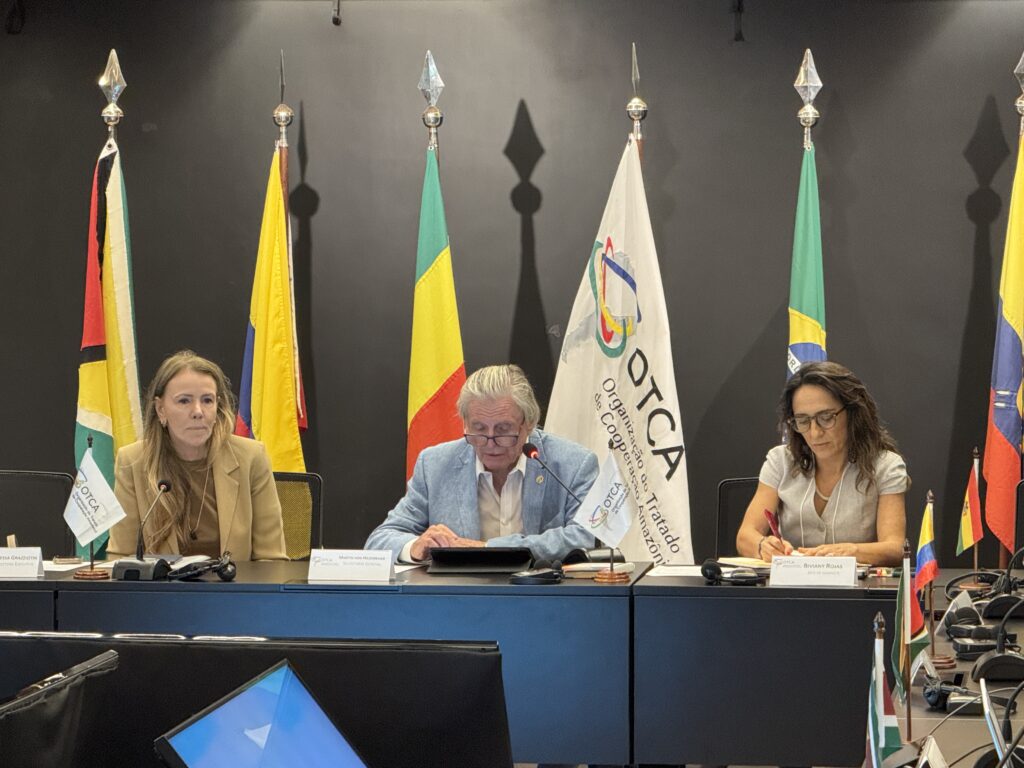
At the opening session, ACTO Secretary-General Martin von Hildebrand highlighted the strategic importance of standing forests for the economy and climate stability, proposing that they be understood as natural infrastructure whose benefits extend far beyond the Amazon.
“The Amazon is a strategic asset whose functions sustain South America’s economy and contribute to the planet’s climate stability,” he stated.
A Continental Hydroclimatic Infrastructure
Water circulating through the atmosphere connects the Amazon to territories far beyond its geographical boundaries. Moisture originating in the tropical Atlantic feeds rainfall across the Amazon Basin, and part of this water returns to the atmosphere through forest evapotranspiration, contributing to further precipitation both within the region and in other parts of South America. This process makes the forest a fundamental component of the continental climate system.
As explained by Jhan-Carlo Espinoza, a researcher at the French National Research Institute for Sustainable Development (IRD), up to 50% of Amazonian precipitation can return to the atmosphere. “The Amazon is not merely a biome: it is part of a continental and global hydroclimatic infrastructure,” he summarized.
However, this system is under increasing pressure. Climate change, deforestation, forest degradation and wildfires affect moisture recycling and atmospheric circulation, while extreme droughts and floods are becoming more frequent and intense. The 2023–2024 drought, for example, affected 88% of the Amazon Basin, illustrating the scale of the risks facing the region.
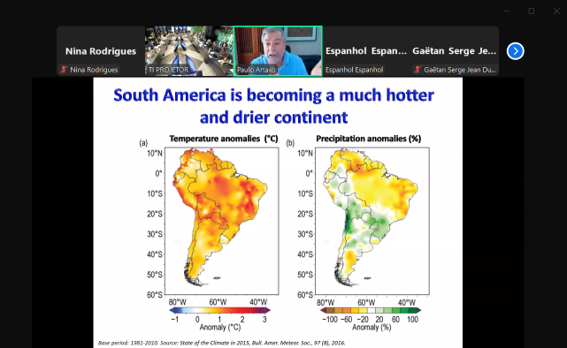
Paulo Artaxo, from the University of São Paulo (USP), and José Marengo, from Brazil’s National Center for Monitoring and Early Warning of Natural Disasters (CEMADEN), provided further insights into the forest’s role in regulating climate and rainfall, as well as the effects of climate change, deforestation and forest degradation on this system. Although scientific knowledge of flying rivers has advanced significantly, important gaps remain in monitoring atmospheric circulation and moisture flows.
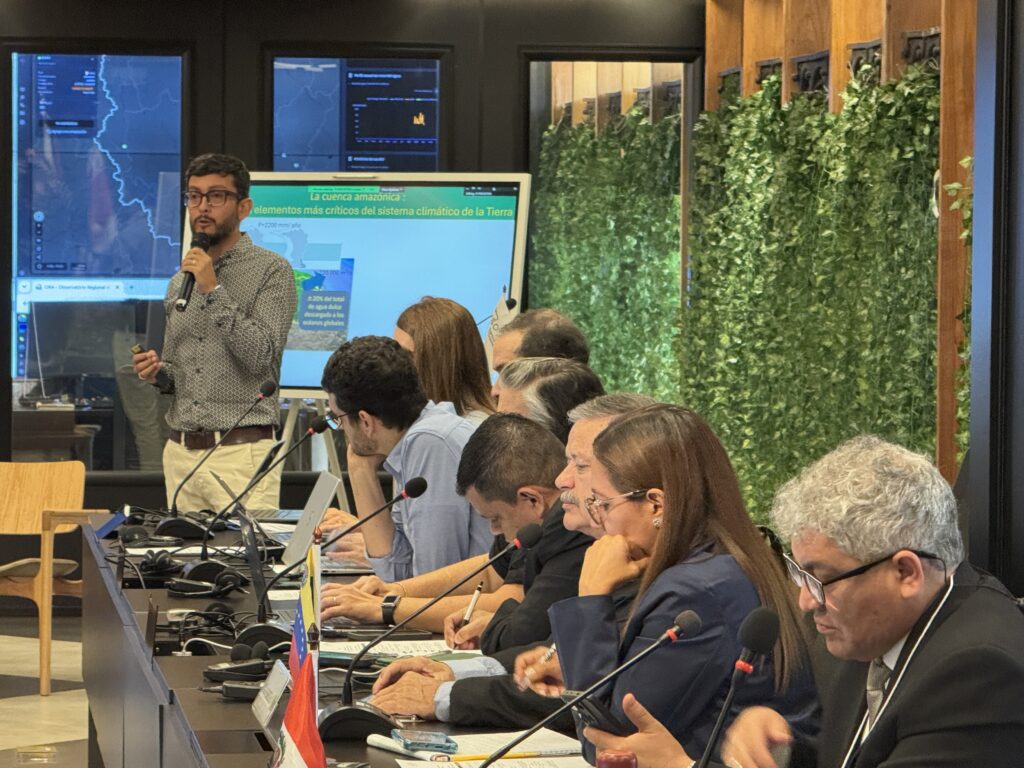
According to Gonzalo Llosa, coordinator of the Amazon Regional Observatory (ARO), advancing this knowledge requires strengthening regional monitoring capacities and integrating information on climate, water resources and forest cover. The ARO already provides a foundation for this work, with a network of 921 hydrological and water quality monitoring stations, as well as information on deforestation, forest degradation and wildfires. Expanding these capacities, including the development of a climate module, could help improve understanding of Amazonian moisture flows and generate information to support decision-making in ACTO Member Countries.
Andes and Amazon: Connected Territories
The territorial dimension of this interdependence was addressed by Luis Daniel Llambí, from the Consortium for the Sustainable Development of the Andean Ecoregion (CONDESAN). The Andes–Amazon connection works in both directions: moisture recycled by the forest contributes to rainfall in Andean regions, while rivers originating in the Andes transport water, sediments and nutrients that are essential to Amazonian ecosystems.
The transition forests between the Andes and the Amazon are hotspots of rainfall and biodiversity and are strategically important in the face of climate change. At the same time, Andean populations and economic activities depend on rainfall originating from the Amazon region.
The key message was the need to “view the region as an integrated whole.” The discussion on resilience reinforced the importance of combining ecosystem conservation and restoration, territorial management and nature-based solutions with a cooperative approach that recognizes the transboundary nature of risks.
The Economic Value of Flying Rivers
The third panel shifted the discussion from hydroclimatic dependence to its economic impacts. Studies presented by Esha Dilip Zaveri, from the World Bank, show that forests act as natural buffers against drought by preserving soil moisture. In the Amazon, estimates link rainfall reductions caused by deforestation between 2001 and 2020 to annual GDP losses ranging from US2.9billiontoUS11.4 billion, in addition to impacts on energy and agricultural productivity.
Gustavo Ribeiro Soares Pinto, from the Climate Policy Initiative/PUC-Rio (Pontifical Catholic University of Rio de Janeiro), presented evidence of the effects on the Brazilian economy, particularly in the hydropower, agriculture and river transport sectors. Rafael Araújo, from the Getulio Vargas Foundation (FGV), demonstrated how economic methods can link changes in forest cover and precipitation to impacts on production and other sectors.
Economic valuation helps make visible relationships of dependence that are still insufficiently incorporated into economic and investment decisions, opening the way for discussions on how beneficiaries of hydroclimatic services can contribute to their conservation.
Edoardo Borgomeo, from the Global Environment Facility (GEF), highlighted a gap in water resources governance: while management systems have traditionally focused on blue water — rivers, lakes and aquifers — green water, held in soils and vegetation and recycled through evapotranspiration, remains largely overlooked in management instruments.
To address this challenge, Borgomeo advocated strengthening and connecting existing institutional mechanisms rather than creating a new treaty specifically for flying rivers. He also proposed adapting financial instruments to recognize and reward the transboundary hydrological services generated by conservation, including payments for ecosystem services, results-based financing and water funds.
From Science to Regional Cooperation
By the end of the Seminar, discussions had converged on the need to translate shared knowledge into a regional work agenda, ensuring the continuity of specialized groups, greater knowledge exchange and coordination among ACTO’s different bodies and mechanisms.
The next steps identified include developing action plans and establishing working groups to explore specific issues in greater depth, as well as accelerating the establishment of the Amazon Network of Meteorological Authorities (RACEM). Coordination with the Amazon Network of Water Authorities (ANWA) and the ARO could help bring together the atmospheric and hydrological dimensions required for regional monitoring of flying rivers.
In his closing remarks, Martin von Hildebrand emphasized that the Seminar was an initial forum for dialogue and that the process should continue. In his view, flying rivers demonstrate particularly clearly the importance of the Amazon beyond its borders and raise the issue of reciprocity for the environmental services provided by the region.
The event thus conveyed a central message: if the hydroclimatic benefits generated by the Amazon cross borders and sustain water supplies, food production, energy generation and economic activities across different territories of South America, protecting them also requires shared knowledge, cooperation, investment and reciprocity at the regional level.