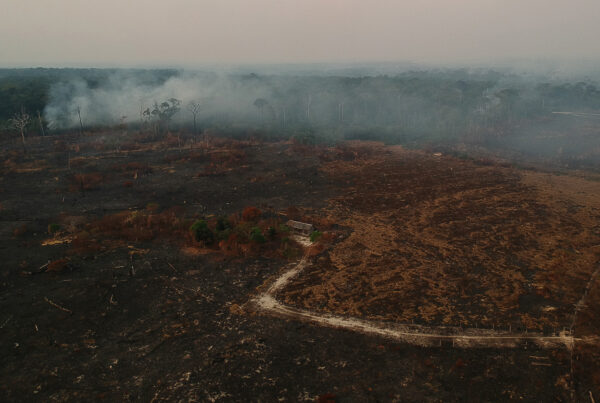
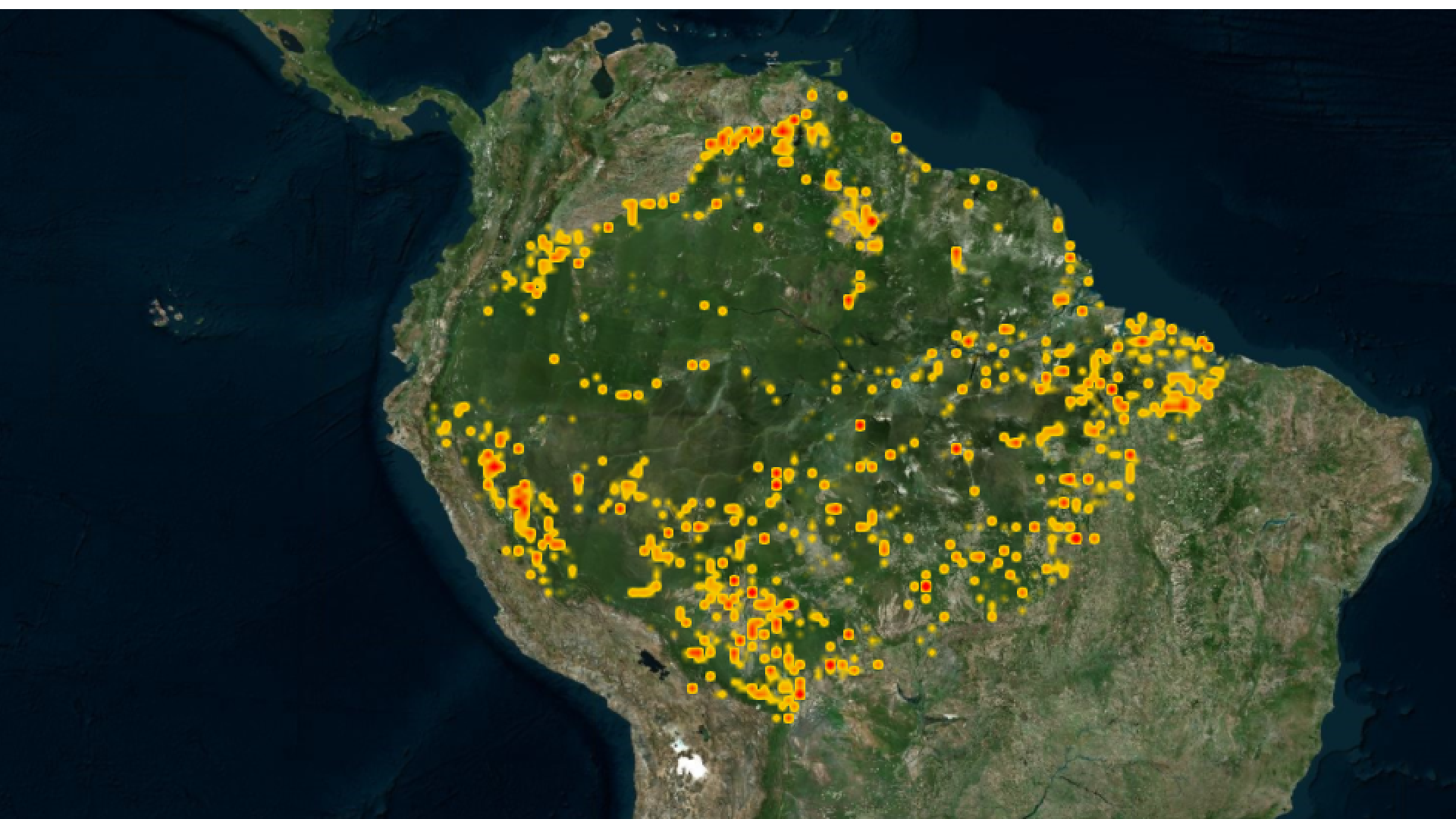
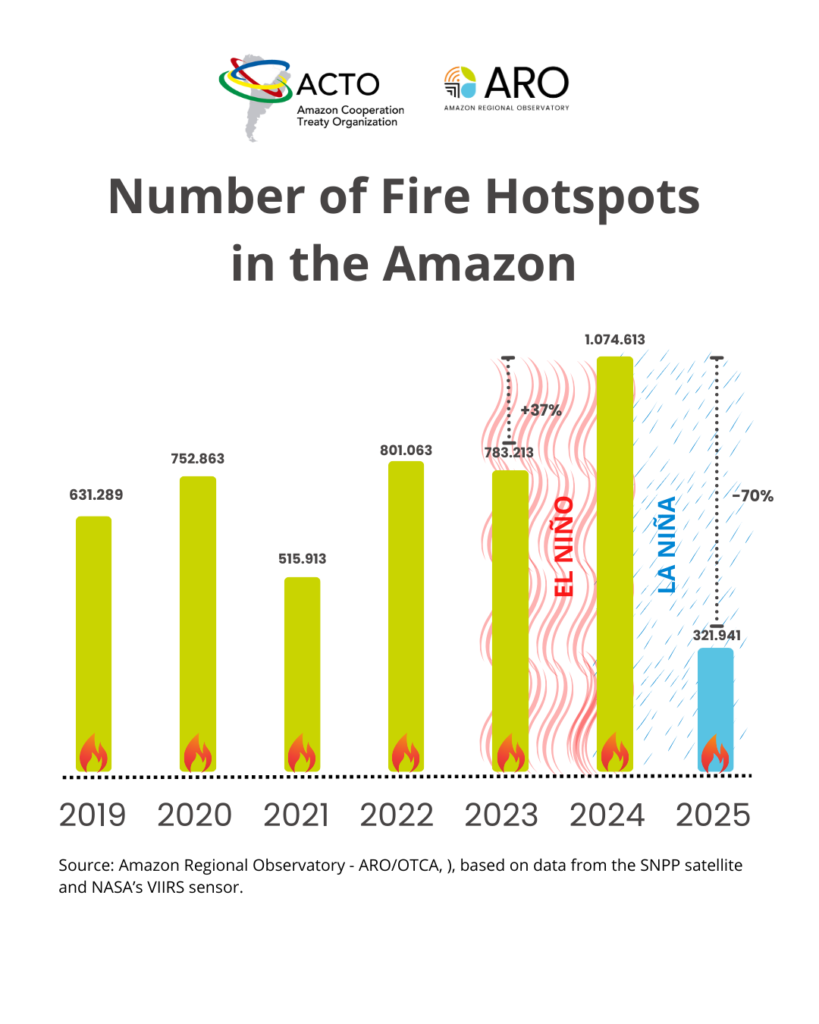
Data from the Amazon Regional Observatory (ARO), of the Amazon Cooperation Treaty Organization (ACTO), show that fire hotspots recorded in the Amazon declined by around 70% in 2025 compared to the previous year. The decrease was observed across all Amazonian countries, indicating a consistent regional trend.
The main explanation for this reduction is linked to the effects of the La Niña climate phenomenon. Characterized by anomalous cooling of the surface waters of the equatorial Pacific Ocean, La Niña alters tropical atmospheric circulation patterns and, in the case of the Amazon, tends to intensify rainfall, especially over large areas of the basin. Increased rainfall and humidity reduce the spread of fire, creating less favorable conditions for forest fires.
To understand the sharp decline in fire hotspots in 2025, it is necessary to look at the behavior of this indicator in previous years. In 2024, ARO monitoring—based on data from the SNPP satellite and NASA’s VIIRS sensor—recorded more than one million fire hotspots in the Amazon. “Between 2023 and 2024, the Amazon experienced severe droughts, which created favorable conditions for the spread of fire. As a result, the number of fire hotspots increased by 37% in 2024 compared to 2023,” explains Maycon Castro, an environmental monitoring specialist at the ARO.
According to Isabelle Vilela, a climate change specialist at the ARO, the extreme drought that occurred in the Amazon in 2023 and 2024 resulted mainly from the unusual and simultaneous combination of anomalous warming of the tropical North Atlantic and El Niño—the anomalous warming of surface waters in the equatorial Pacific Ocean—both intensified by rising global temperatures.
In 2025, under the influence of La Niña, the number of fire hotspots dropped sharply to just over 320,000, considering the eight ACTO member countries (Bolivia, Brazil, Colombia, Ecuador, Peru, Guyana, Suriname, and Venezuela).
“Although El Niño and La Niña are periodic phenomena, recent studies indicate that global warming is changing their frequency and intensity and amplifying their climatic effects,” Vilela explains.
Effects of global climate
“The Amazon is highly susceptible to the effects of the global climate. These effects can occasionally inhibit ignition points, as observed with the rains of 2025, but climate change can also make the Amazon region extremely flammable, as occurred in 2023, when the region faced a severe drought associated with El Niño that culminated, in 2024, in the high incidence of fire hotspots observed in the region,” says Arnaldo Carneiro, coordinator of the ARO.
Despite the influence of climatic factors, experts warn that fire hotspots in the Amazon are largely associated with human activities. In 2025, about 35% of fire hotspots occurred in forest areas and 25% in pastures. This share was slightly higher in 2024, when 38% of fire hotspots occurred in forest areas and 28% in pastures. Among the main causes are deforestation, pasture management using fire, and forest fragmentation, which makes vegetation more vulnerable to ignition and the spread of fire. During periods of drought, these practices tend to intensify, significantly increasing the risk of large-scale wildfires.
About the ARO
The Amazon Regional Observatory (ARO) is a strategic initiative of ACTO aimed at producing, integrating, and disseminating scientific data and information on the Amazon region. The ARO brings together environmental indicators from the eight ACTO member countries with the objective of supporting public policy formulation, strengthening regional cooperation, and supporting evidence-based decision-making. In the environmental field, the Observatory monitors, among other aspects, deforestation, fire hotspots, climate change, and biodiversity, contributing to an integrated, regional-scale view of the Amazon.