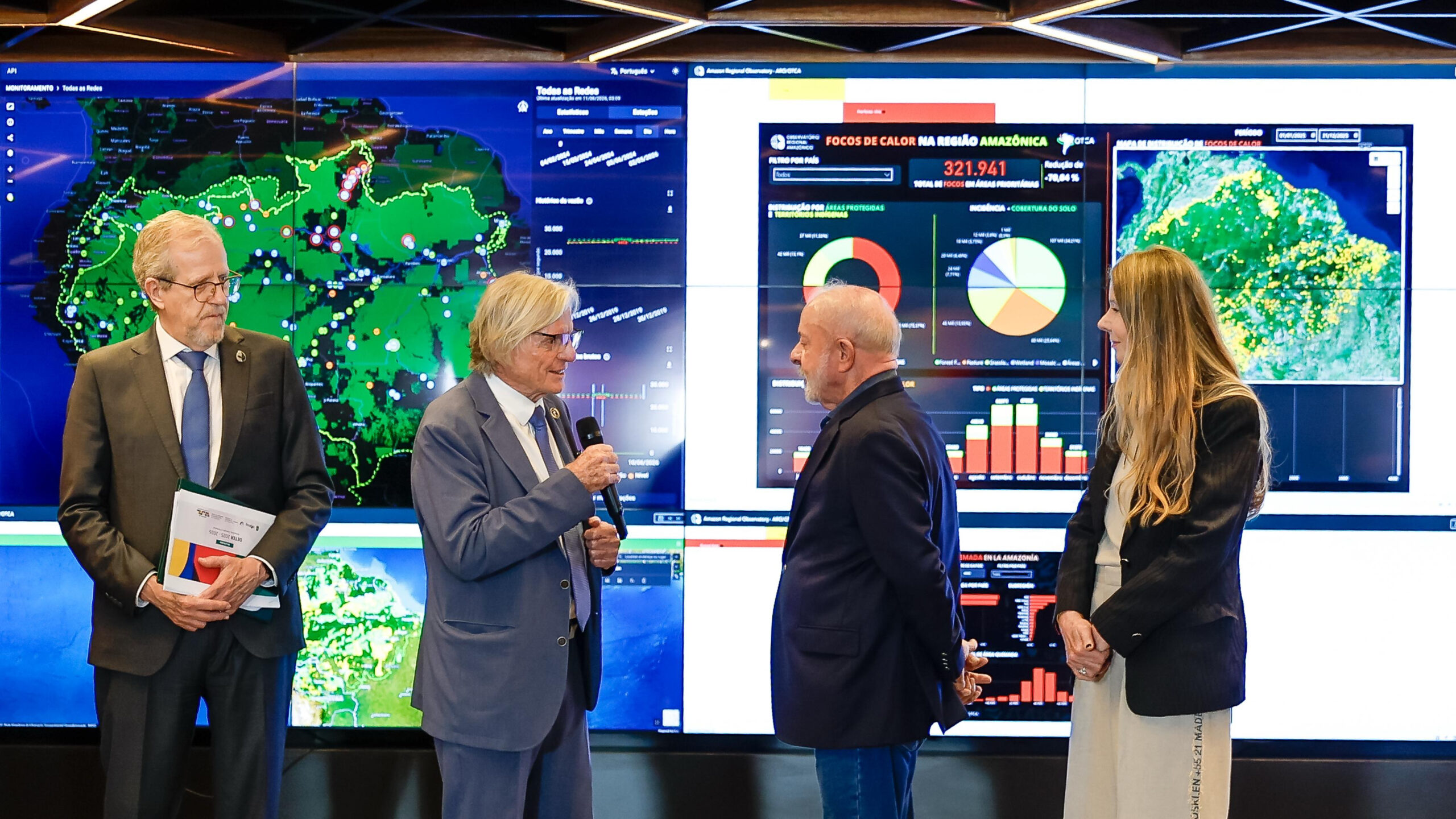
The President of the Federative Republic of Brazil, Luiz Inácio Lula da Silva, visited the Amazon Regional Observatory (ARO) on Thursday (11). The platform, developed by the Amazon Cooperation Treaty Organization (ACTO), is dedicated to monitoring the Amazon and strengthening regional cooperation among Amazonian countries.
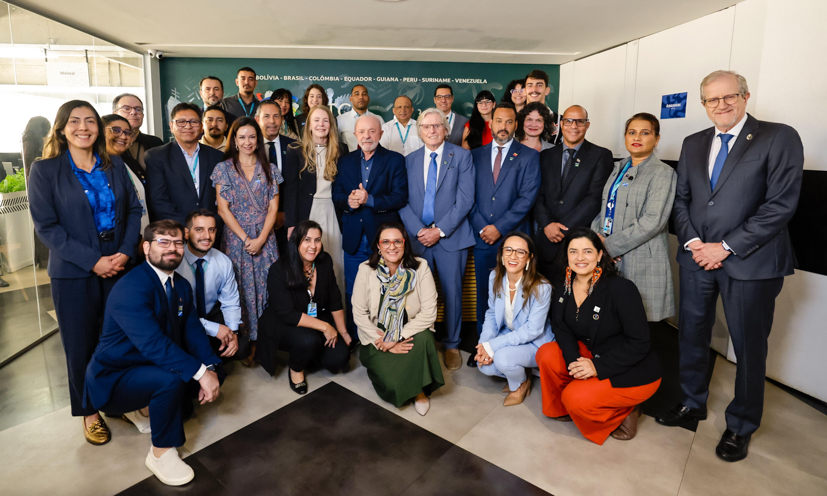
Accompanied by ministers and federal authorities, the President learned about the monitoring and territorial intelligence tools developed by ACTO to support the sustainable management of the Amazon and strengthen cooperation among the eight Amazonian countries. During the visit, Brazil’s Ministry of the Environment and Climate Change (MMA) and the Ministry of Science, Technology and Innovation (MCTI) presented the latest data on progress achieved in reducing deforestation in the Brazilian Amazon and the Cerrado.
President Lula attended a presentation by ACTO technical specialist Maycon Castro on ARO’s thematic modules covering water resources, wildfires, deforestation, and biodiversity across the Organization’s eight Member Countries.
During the visit, the President highlighted ACTO’s strategic relevance as a platform for regional coordination and recalled the progress made since the Amazon Summit held in Belém in 2023.
“After the meeting we held in Belém, we decided that if we have an institution that represents all Amazonian countries, we have the responsibility to strengthen it,” he said.
Lula also reaffirmed the Brazilian government’s commitment to the environmental agenda and its goal of achieving zero deforestation by 2030.
ACTO Secretary General Martin von Hildebrand emphasized that the Organization’s main strength lies in enabling Amazonian countries to act in a coordinated manner in addressing shared challenges, transforming data and scientific knowledge into concrete cooperation initiatives.
Von Hildebrand stressed that conserving the Amazon is essential for water, energy, and food security throughout South America.
“The Amazon is not a distant issue. The water we drink and a large share of South America’s food production depend on the ecological processes of the forest. Protecting the Amazon is therefore a shared responsibility among all countries in the region,” the Secretary General stated.
Brazilian Amazon Records Lowest Deforestation Levels in Recent Years
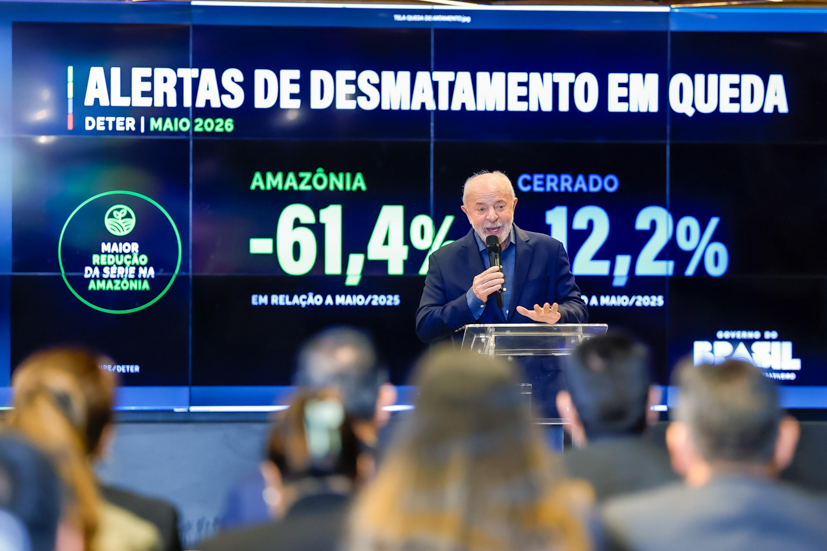
Recent data from Brazil’s Real-Time Deforestation Detection System (Deter) show a significant decline in deforestation in both the Cerrado and the Brazilian Amazon. These results are consistent with the broader regional trend across the Amazon Basin, as previously reported by ACTO.
In the Brazilian Amazon, deforested areas decreased by 61.4% compared to May 2025, representing the largest reduction recorded for the period.
In the Cerrado, deforestation declined by 12.2% compared to May 2025.
According to André Lima, Extraordinary Secretary for Deforestation Control and Territorial Environmental Planning at the Ministry of the Environment and Climate Change, the results reflect the progress achieved through environmental monitoring and enforcement policies and reinforce Brazil’s commitment to achieving zero deforestation by 2030.
President Lula emphasized that this target was established by the Brazilian government itself and reaffirmed the importance of continuous monitoring and regional cooperation for the conservation of the Amazon.
Representing ACTO Member Countries, the ambassadors of Brazil, Peru, Suriname, and Venezuela attended the visit, along with Bolivia’s Chargé d’Affaires and Colombia’s Minister Counselor. Representing the Brazilian government were João Paulo Capobianco, Minister of the Environment and Climate Change, and his team; Luciana Santos, Minister of Science, Technology and Innovation, and her team; the presidents of the Brazilian Institute of Environment and Renewable Natural Resources (IBAMA) and the Chico Mendes Institute for Biodiversity Conservation (ICMBio); as well as representatives of Brazil’s National Institute for Space Research (INPE).