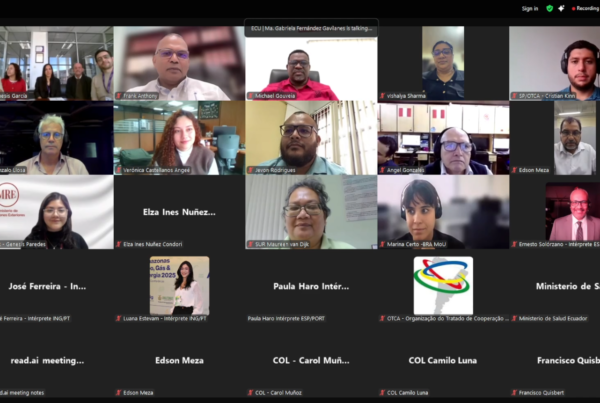

A workshop titled “Data and Information for the Implementation of Integrated Fire Management in the Amazon Region: “Fire Data,” a forum bringing together experts, technical institutions, international agencies, and representatives from the eight ACTO member countries to strengthen regional cooperation in the face of the growing risk of forest fires in the Amazon.
The event is organized by the Amazon Regional Observatory (ORA) of ACTO, in partnership with the CoRAmazonia project (GIZ), the Global Fire Hub of the Food and Agriculture Organization of the United Nations (FAO), and the Amazon Environmental Research Institute (IPAM).
The workshop aims to develop a comprehensive, up-to-date overview of the data, systems, and tools available for addressing forest fires in the Amazon, strengthening evidence-based and geospatial decision-making.
During the opening session, ACTO’s Environment Coordinator, Carlos Salinas, highlighted that regional work on wildfires and integrated fire management is the result of more than a decade of technical and political collaboration among Amazonian countries, strengthened following the Belém Declaration and the implementation of the Memorandum of Understanding on Integrated Fire Management among ACTO Member Countries.
Salinas recalled that the Amazon Network for Integrated Fire Management (RAMIF) was established in 2023 and that the 2024–2026 Work Plan is currently being implemented, alongside new mechanisms for operational cooperation among Amazonian countries.
“Integrated fire management requires reliable information, regional cooperation, and joint response capacity. No country can face alone the challenges the Amazon is experiencing today,” he stated.
The workshop also included the participation of representatives from German cooperation agencies, scientific institutions, and international organizations. Gustavo Wachtel, coordinator of GIZ’s CoRAmazonia Project, emphasized the importance of bringing together specialists from different countries and disciplines to exchange experiences and generate regional solutions geared toward action.
In turn, Duarte Oom, a wildfire remote sensing specialist at the Food and Agriculture Organization of the United Nations (FAO), highlighted the importance of advancing toward regional systems capable of transforming data into strategic information for decision-making.
“Today, the major challenge is not only generating data, but transforming it into useful information that supports integrated fire management and strengthens the response capacity of Amazonian countries,” he stated during the opening of the meeting.
Likewise, Ane Alencar, Science Director at the Amazon Environmental Research Institute (IPAM/Brazil), emphasized the importance of strengthening cooperation networks and information exchange among institutions that produce and use wildfire data.
“We hope these two days will help us better understand the existing gaps, strengthen our networks, and expand collaboration among those who produce, analyze, and use information on fire in the Amazon,” she stated.
ARO strengthens regional data integration and raises awareness of climate risks
During the workshop, the Coordinator of the Amazon Regional Observatory (ARO), Arnaldo Carneiro, presented the observatory’s progress in integrating official data platforms on the Amazon and warned about the accelerating degradation of the Amazon biome, driven by deforestation, wildfires, and the increasingly severe effects of the climate crisis.
Carneiro highlighted that the ARO has been consolidating its role as a strategic regional platform to transform large volumes of information into useful tools for decision-making.
In addition, he emphasized the importance of strengthening partnerships among governments, scientific institutions, civil society, and international organizations to expand the region’s capacity for anticipation, adaptation, and response to extreme events affecting the Amazon.
Technical agenda and capacity strengthening
During the two days of work, specialists and representatives from Amazonian countries will discuss Earth observation technologies, satellite monitoring, data interoperability, early warning systems, regional platforms, and tools for wildfire prevention, response, and restoration.
The agenda also includes technical panels on information gaps, capacity-strengthening needs, and the role of the Amazon Regional Observatory (ARO) in integrating strategic data for Integrated Fire Management (IFM).
The Fire Data Workshop takes place on May 21 and 22 in Brasília and is part of the actions promoted by ACTO to strengthen regional Amazon cooperation in addressing the climate, environmental, and territorial challenges faced by the region, in a context marked by increasing extreme droughts, wildfires, and growing pressure on Amazon ecosystems.