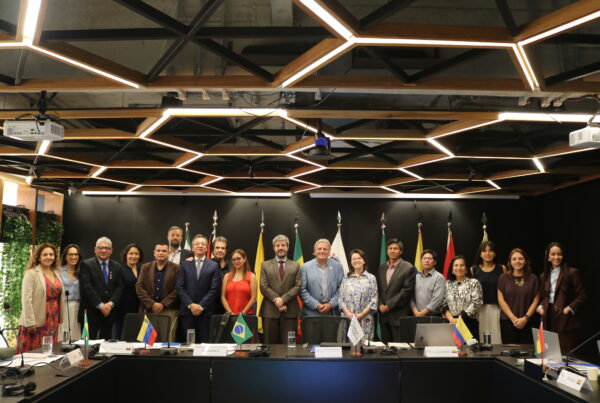
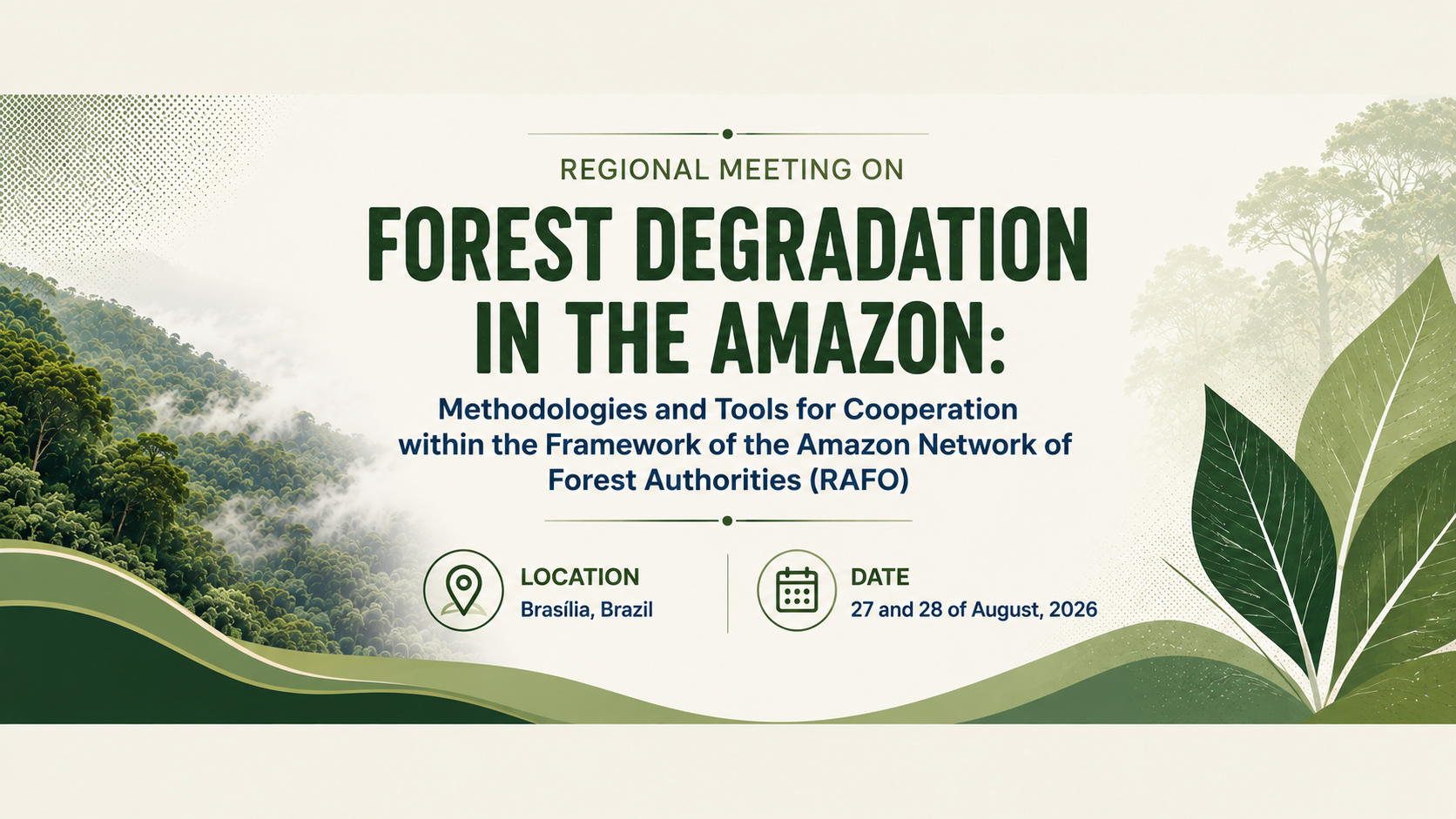
Brasília, August 26, 2026. Representatives of the eight Member Countries of the Amazon Cooperation Treaty Organization (ACTO) will meet on August 27 and 28 in Brasília to exchange experiences, analyze methodologies, and advance the development of common elements to strengthen the monitoring and management of forest degradation in the Amazon.
The Regional Meeting on Forest Degradation in the Amazon: Methodologies and Tools for Cooperation within the Framework of the Amazon Network of Forest Authorities (RAFO) will be held at the headquarters of the ACTO Permanent Secretariat and will bring together authorities and experts from the Member Countries, as well as technical and scientific institutions and representatives of Indigenous Peoples and local communities.
Forest degradation is one of the major challenges facing Amazonian ecosystems due to its impacts on biodiversity, climate change, ecosystem services, and the livelihoods of populations that depend on forests. Unlike deforestation, identifying and measuring forest degradation involves specific technical and methodological challenges, particularly when seeking to understand the phenomenon at the regional level.
Although Amazonian countries have national monitoring systems and valuable technical experience, challenges remain in harmonizing methodologies, improving the comparability of information, and integrating data to build a regional understanding of the scale, causes, and dynamics of forest degradation.
In this context, the meeting seeks to strengthen regional technical and scientific cooperation within the framework of the implementation of the 2025–2027 Work Plan of the Amazon Network of Forest Authorities (RAFO) and its coordination with the Amazon Regional Observatory (ARO). The objective is to improve the understanding, monitoring, and management of forest degradation through knowledge exchange, the use of satellite data, and the development of recommendations and tools that contribute to decision-making and sustainable forest management in the Member Countries.
From national experiences to a regional perspective
During the first day, participants will address concepts and approaches related to forest degradation and learn about the experiences of Bolivia, Brazil, Colombia, Ecuador, Guyana, Peru, Suriname, and Venezuela, including their monitoring systems, key gaps, and challenges.
The program will also include technical contributions from the Food and Agriculture Organization of the United Nations (FAO), Brazil’s National Institute for Space Research (INPE), and the European Commission’s Joint Research Centre (JRC), as well as a dedicated session on the experiences and perspectives of Indigenous Peoples and local communities.
One of the central topics will be the connection between information generated by national systems and a regional perspective. Participants will analyze the information available through the ARO and the needs identified by the RAFO, as well as the opportunities offered by JRC and Copernicus satellite tools to identify trends, visualize regional information, and support decision-making.
The second day will focus on deepening the discussion on monitoring methodologies and tools and, particularly, on translating technical exchanges into cooperation proposals. Participants will examine existing technical, institutional, and methodological gaps and develop common elements for a regional proposal on data, capacities, and regional and international cooperation.
As an expected outcome of the meeting, participants will advance recommendations for RAFO’s roadmap, identifying actions, priorities, coordination mechanisms, and next steps to strengthen Amazonian cooperation in addressing forest degradation.
Regional cooperation to strengthen forest monitoring
The meeting responds to the priorities defined by the Member Countries within the RAFO, which was established under the mandate of the 2023 Belém Declaration to strengthen the implementation of ACTO’s Regional Forest Program and coordination among forest authorities across the region.
The process is also linked to strengthening the Amazon Regional Observatory (ARO) as a regional platform for integrating information, data, and knowledge from national systems and scientific sources, contributing to a shared Amazonian perspective and evidence-based decision-making.
The meeting is organized by the ACTO Permanent Secretariat, with support from the European Union’s Amazonia+ Program and the European Commission’s Joint Research Centre (JRC). Technical guidance will be provided by ACTO, the JRC, and Peru’s National Forest and Wildlife Service (SERFOR), in its capacity as Pro Tempore Presidency of RAFO.
The Amazonia+ Program, funded by the European Union, supports this regional technical and scientific cooperation process and facilitates the exchange of knowledge, methodologies, and good practices to strengthen forest monitoring and the prevention of deforestation and forest degradation in the Amazon.