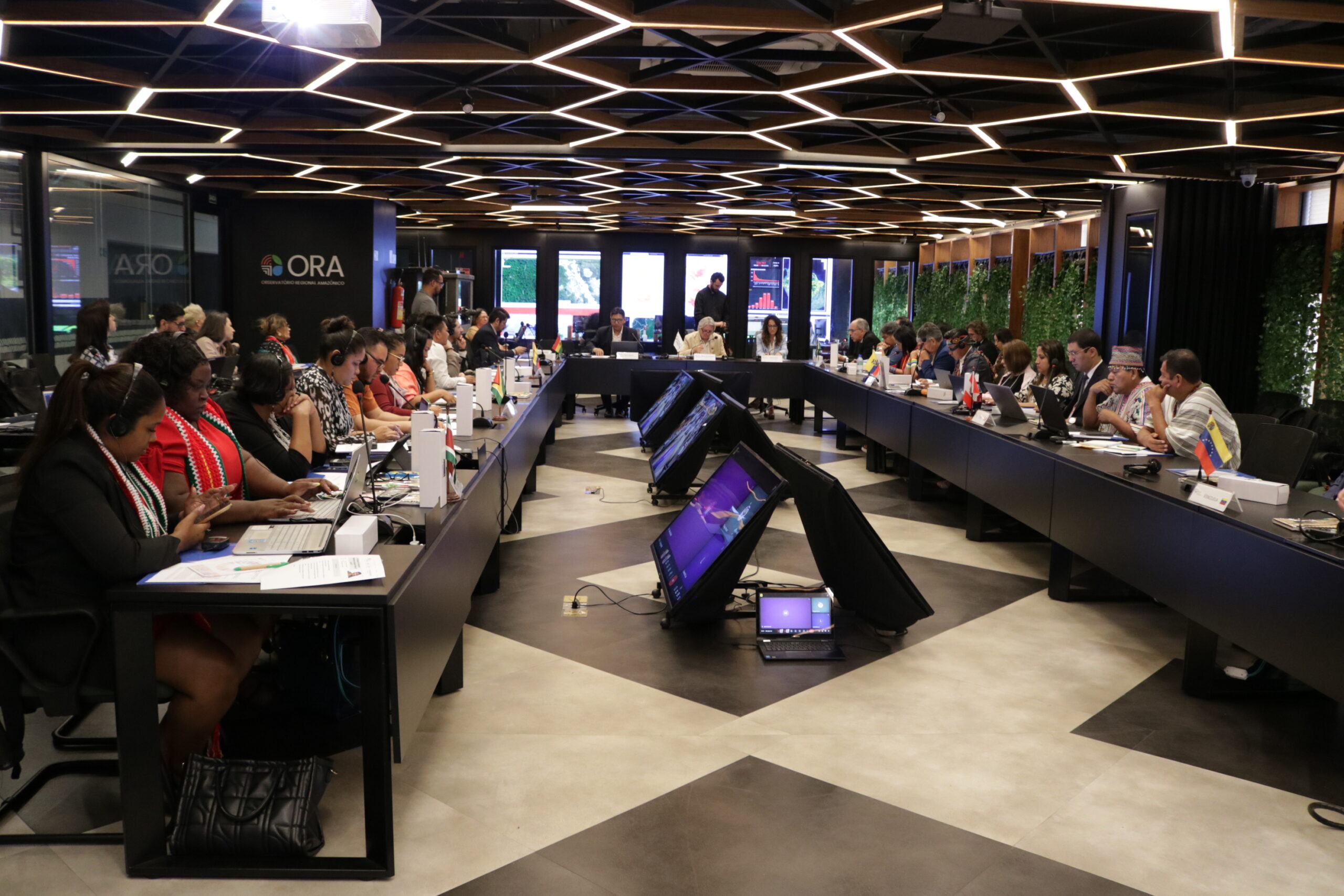
From a process of collective development to the institutionalization of equal dialogue, the Amazonian Mechanism of Indigenous Peoples marks a milestone in regional cooperation by permanently incorporating Indigenous participation into the governance of the Amazon.
The consolidation of the Amazonian Mechanism of Indigenous Peoples (MAPI) marks a new stage in the regional governance of the Amazon. More than a forum for dialogue, MAPI provides a permanent space for participation and consensus-building that recognizes Indigenous Peoples as key political actors in protecting territories, biodiversity, traditional knowledge, and Amazonian ways of life.
Established within the framework of the Amazon Cooperation Treaty Organization (ACTO), MAPI is the result of a regional process of institutional development led by the Member Countries, with the participation of Amazonian Indigenous Peoples and other strategic actors. The initiative is aimed at strengthening the participation of Indigenous Peoples in governance processes and the sustainable management of the Amazon, while helping consolidate MAPI as a permanent mechanism for dialogue, coordination, and regional cooperation.
A path built step by step
MAPI did not emerge overnight. It is the result of a long political, diplomatic, and technical process that gained momentum with the Belém Declaration, adopted in 2023 by the Presidents of the Member Countries, and was consolidated with the approval of Resolution 17 during the Fifth Meeting of Presidents of the States Parties to the Amazon Cooperation Treaty, held in Bogotá in 2025.
Behind that decision was an intensive process of dialogue and negotiation between Amazonian governments and Indigenous organizations. Juan Carlos Alurralde, who served as the Bolivian government’s principal delegate and coordinator of Working Group 7 (WG7), followed the negotiations from their earliest stages and recalls that approximately 18 sessions were needed to build the consensus that shaped the mechanism.
“The equal representation structure was a non-negotiable demand of Indigenous organizations.”
— Juan Carlos Alurralde – Bolivia, WG7 Coordinator
His testimony reflects one of the main challenges of those negotiations: designing a structure that could reconcile the institutional frameworks of States with recognition of Indigenous Peoples’ own forms of representation, their right to self-determination, and their participation in decisions concerning the territories they have historically protected.
Drawing on her experience, Gabriela Belmonte, representative of the Government of Venezuela, considers that the process marked a turning point in ACTO’s history.
“For the first time in ACTO’s history, Indigenous Peoples sat alongside governments to build a single Amazonian voice.”
— Gabriela Belmonte – Venezuela
Beyond the approval of a new mechanism, the process made it possible to build a different form of regional dialogue, based on mutual recognition, consensus-building, and shared responsibility between States and Indigenous Peoples. This spirit of collective development is precisely one of the main features that distinguishes MAPI within ACTO’s institutional architecture.
The innovation of equal co-governance
One of MAPI’s most significant features is its model of equal co-governance. By bringing together government representatives and Indigenous Peoples’ organizations within the same dialogue structure, the mechanism helps move beyond traditional models of occasional consultation and strengthens an approach based on joint decision-making. The central principle is simple yet transformative: decisions about the Amazon should systematically take into account the voices of those who live in these territories and have historically contributed to their conservation.
For Juan Carlos Alurralde, one of the mechanism’s main contributions is precisely the change it introduces into the relationship between States and Indigenous Peoples.
“MAPI transforms ACTO’s architecture: Indigenous Peoples are no longer merely consulted but move toward a more active role in governance.”
— Juan Carlos Alurralde – Bolivia, WG7 Coordinator
This perspective gives the mechanism strategic value for regional cooperation. By bringing together the eight Amazonian countries and Indigenous organizations, ACTO strengthens its role as a platform for intercultural dialogue and as a space capable of connecting technical, political, and territorial agendas. MAPI links territorial protection, collective rights, biodiversity, development with social justice, and ancestral knowledge.
Marco Antonio Humes Méndez, representative of Bolivia’s Ministry of Foreign Affairs, emphasizes that MAPI already has a defined institutional foundation and that the challenge now is to move toward concrete implementation.
“MAPI is already consolidated because the countries agreed on Resolution 17, which establishes the foundations for its operation.”
— Marco Antonio Humes Méndez – Bolivia
The challenge of turning agreements into action
With the approval of its main operational instruments, MAPI is now entering a new stage. Implementing its strategic pillars, thematic working groups, and guidelines; advancing the 2026–2027 Work Plan; and strengthening coordination between the Member Countries and Indigenous representatives will be critical to consolidating this new model of governance.
Marco Antonio Humes Méndez, representative of Bolivia’s Ministry of Foreign Affairs, emphasizes that the mechanism has a solid institutional foundation from which to advance into this new stage.
“MAPI is already consolidated because the countries agreed on Resolution 17, which establishes the foundations for its operation.”
— Marco Antonio Humes Méndez – Bolivia
For Ângela Amankwa, MAPI co-chair representing Indigenous Peoples and a representative of the Coordination of Indigenous Organizations of the Brazilian Amazon (COIAB), the mechanism also symbolizes recognition of a role that Indigenous Peoples have historically played.
“We, Indigenous Peoples, also manage, protect, and care for the Amazon through our own systems of governance.”
— Ângela Kaxuyana – Brazil
The consolidation of MAPI represents a decisive step toward strengthening more inclusive, intercultural, and participatory Amazonian governance. In a region facing growing pressures from climate change, biodiversity loss, and conflicts over land use, the mechanism opens a new space for building joint responses through dialogue, mutual recognition, and regional cooperation.
The testimonies featured in this article are part of the first Amazonian Voices series, an initiative that brings together the experiences and perspectives of Indigenous representatives, government delegates, and other actors who participated in the development and implementation of the Amazonian Mechanism of Indigenous Peoples (MAPI). Amazonian Voices is developed under the Indigenous Roots for Amazonian Governance Grant (RAIGA), and the series will continue to incorporate new voices from ACTO’s eight Member Countries, with the aim of preserving the memory of this regional cooperation process.
The Indigenous Roots for Amazonian Governance Grant (RAIGA) accompanies and supports the dialogue processes of the Amazonian Mechanism of Indigenous Peoples (MAPI). The grant is implemented by the ACTO Permanent Secretariat under the Amazonia+ Program, funded by the European Union and implemented by the Italian Agency for Development Cooperation (AICS), the International and Ibero-American Foundation for Administration and Public Policies (FIIAPP), and Expertise France.